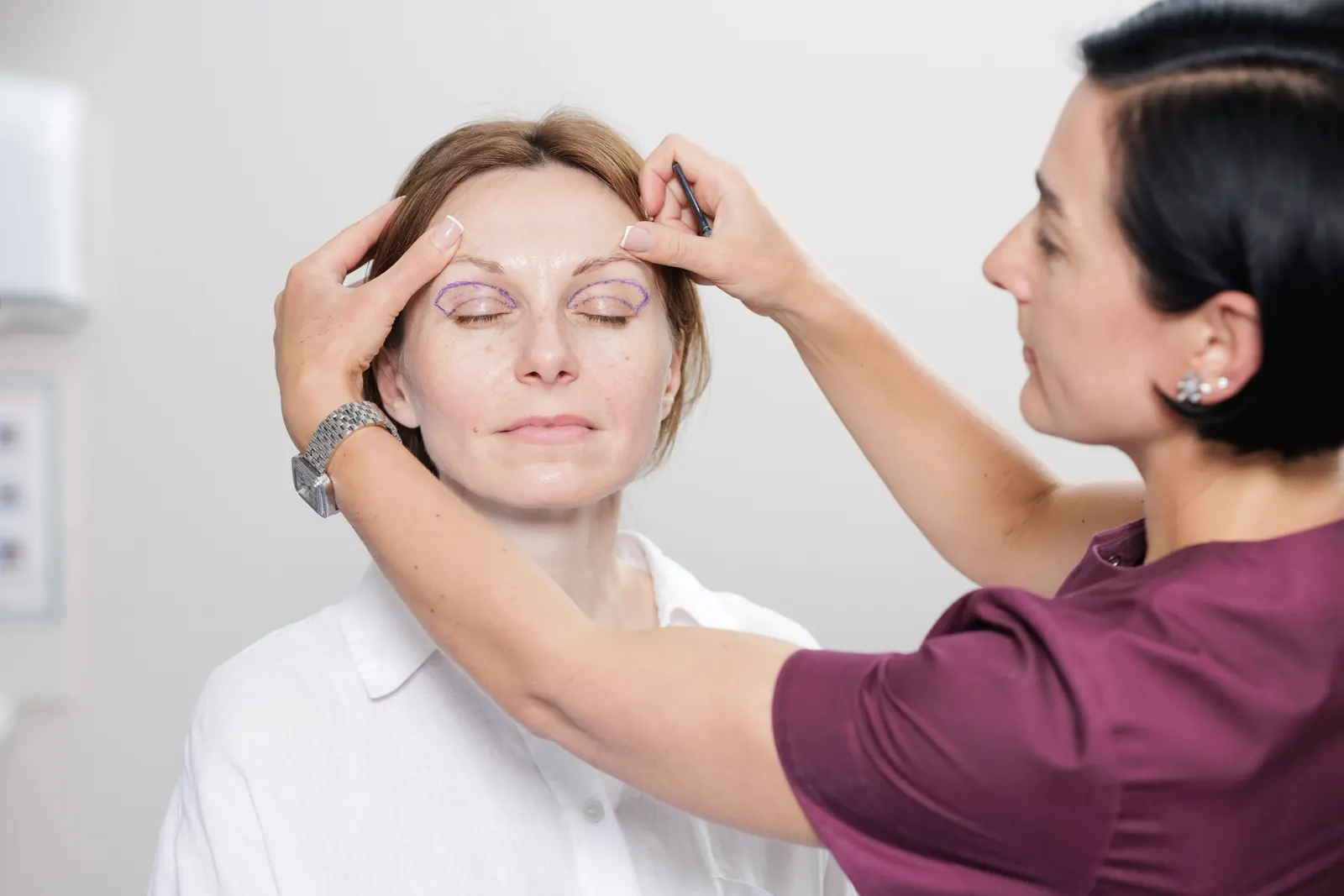
Blepharoplasty, or eyelid surgery, reshapes the eyelids by removing or repositioning excess skin, muscle and fat. It is most often used to reduce heavy or hooded upper lids and puffiness or bags below the eyes, which can help you look less tired. Where heavy upper lids affect your field of vision, it may also have a functional benefit.
“Eyelid surgery” actually covers several related but distinct procedures. Some remove or reposition skin and fat on the upper or lower lids; others reshape or support the outer corner of the eye. They are not interchangeable, and what suits you depends on which part of the eyelid is involved and what you want to change. The main approaches are set out below.
It is worth being clear about the limits. Blepharoplasty does not remove dark circles or pigmentation, soften crow’s feet, or change the position of your eyebrows on its own; those concerns are addressed in other ways. Your surgeon can explain which of your concerns eyelid surgery can and cannot help with.
Types & techniques
The names below describe the main approaches you may come across. They are often combined, and which is appropriate depends on your anatomy and goals, something only a qualified surgeon can advise on.
Upper blepharoplasty
Removes or repositions excess skin, and sometimes a small amount of fat, from the upper eyelids to reduce hooding and heaviness. Where heavy upper lids obstruct the field of vision, it can also improve sight.
Lower blepharoplasty
Addresses puffiness, eye bags or loose skin below the eyes by removing or repositioning fat and, where needed, tightening the skin. Incisions are often hidden inside the lower lid or just beneath the lashes.
Skin-pinch blepharoplasty
A more conservative lower-lid technique that removes only a small pinch of excess skin, leaving the underlying fat and muscle undisturbed. It suits fine skin excess rather than significant bags.
Canthoplasty
A procedure on the outer corner of the eye (the lateral canthus) that detaches and repositions the supporting tendon to reshape or firm the lower lid. It is used to correct or prevent lower-lid laxity, or to alter eye shape.
Canthopexy
A less invasive way to tighten and support the outer corner of the eye without fully detaching the tendon. It reinforces the lower lid and is sometimes combined with a lower blepharoplasty.
Fox eye / cat eye lift
A general term for procedures that create a more lifted, elongated outer-corner appearance. It may involve canthoplasty, canthopexy, or brow and temple lifting rather than a single defined operation, and results vary considerably.
Who might consider it
The points below describe reasons people commonly explore this procedure. They are not eligibility criteria, only a qualified surgeon who has assessed you can advise whether it is appropriate for you.
People with excess upper-lid skin or lower-lid puffiness.
People whose upper-lid heaviness affects their vision.
Suitability is assessed individually by a qualified surgeon.
What happens during the procedure
1Often under local anaesthetic with sedation, fine incisions are placed in the natural eyelid creases (or inside the lower lid) so scars are well hidden.
2Excess skin and fat are removed or repositioned and the incisions closed.
Recovery, stage by stage
First 24–48 hoursBruising and swelling; cool compresses and rest help.
First weekSutures typically removed around day 5–7.
Weeks 2–4Most bruising fades within 2–3 weeks.
Return to workOften 7–10 days.
ExerciseLight activity from around 2 weeks.
Longer termScars settle and fade over several months.
Risks & considerations
Every procedure carries risks. The general points below are for information only and are not a complete list.
Bleeding, infection and anaesthetic risks.
Dry, irritated eyes, temporary blurred vision or difficulty closing the eyes.
Asymmetry or, rarely, changes to eyelid position.
The risks that apply to you, and how likely they are, can only be assessed in person by a qualified, GMC-registered clinician who has assessed your health and goals. Nothing here is medical advice.
Cost
As a guide, this procedure typically costs in the region of £3,000 to £6,000. This is an indicative range to help you plan, not a quote. A surgeon will confirm your own cost only after assessing you.
What the price usually covers
Consultation
Sometimes redeemable against the procedure if you decide to go ahead.
Surgeon’s fee
Reflects the surgeon’s training, experience and time in theatre.
Hospital / theatre
Facility, nursing and any overnight stay.
Anaesthesia
The anaesthetist’s fee, where a general anaesthetic is used.
Aftercare & follow-ups
Dressings, support garments and review appointments, check what is included.
Revision policy
What a further procedure would cost if one were ever needed.
What affects the price
Whether upper, lower or both eyelids are treated.
Anaesthetic type and clinic setting.
Questions to ask your surgeon
A good consultation is a two-way conversation. Consider taking these questions with you.
How many of these do you carry out each year, and what are your own complication rates?
What result is realistic for me specifically, and what are the limitations?
What are the main risks in my case, and how would any complications be handled?
What exactly does the quoted price include, and what would a revision cost?
Where will the procedure take place, and who provides my aftercare and follow-up?
Breast augmentation, Breast reduction, Breast uplift, Breast reconstruction, DIEP flap breast reconstruction, Abdominoplasty, Liposuction, Arm lift, Thigh lift, Body lift, Blepharoplasty, Facelift, Neck lift, Labiaplasty, Lymphoedema surgery, Lipoedema surgery, Skin lesion surgery, Non-surgical aesthetics
Clinic
Cayman Surgery
Governors Square, Unit 4-113, 23 Lime Tree Bay Avenue, Grand Cayman, KY1-1208, Cayman Islands
MBBS, BSc (Hons), FRCS (Plast), Hand Dip (Br), EBHS
18+ Years experience
GMC 7021343
London
Specialities
Breast augmentation, Breast uplift (mastopexy), Breast uplift with implants, Breast reduction, Breast auto-augmentation (own tissue), Breast revision surgery, Tummy tuck (abdominoplasty), Mummy makeover, Liposuction, Body contouring after weight loss, Arm lift, Thigh lift, Labiaplasty, Eyelid surgery (blepharoplasty), Ear pinning (pinnaplasty)
Not directly. Blepharoplasty addresses excess skin and fat; pigmentation and hollowing are treated in other ways. Discuss your specific concern at consultation.
Is the recovery quick?
Downtime is relatively short, but bruising can last a couple of weeks and everyone heals at their own pace.
We use cookies to improve your browsing experience
For more information please refer to our Privacy Policy.