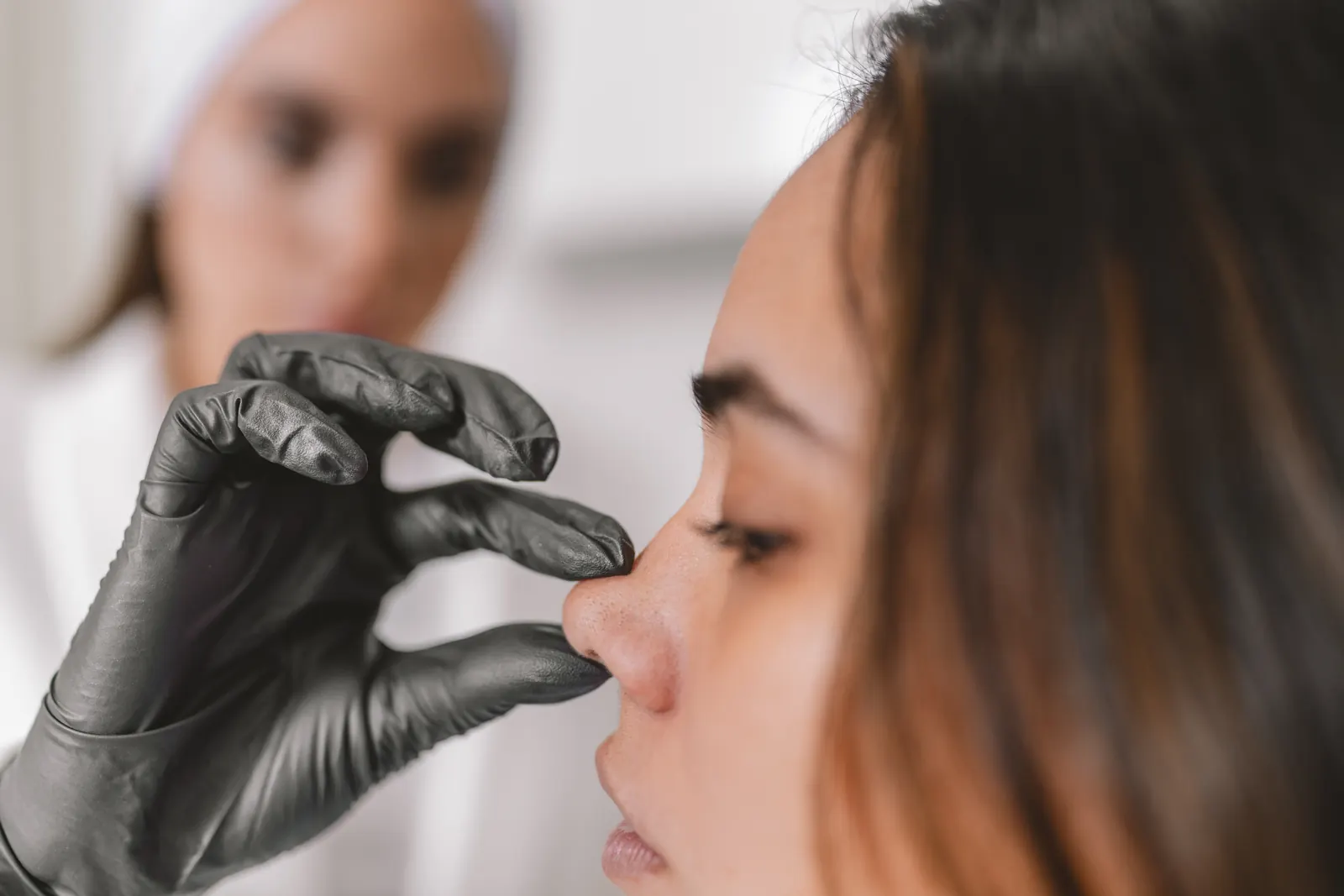
Non-surgical rhinoplasty uses dermal filler to camouflage a small bump or refine minor contour irregularities.
It can only add volume, it cannot reduce the size of the nose or fix breathing.
It is temporary and, on the nose specifically, carries particular safety considerations.
Who might consider it
The points below describe reasons people commonly explore this procedure. They are not eligibility criteria, only a qualified surgeon who has assessed you can advise whether it is appropriate for you.
People with a minor contour concern who want a temporary, non-surgical option.
It is not suitable for reducing nose size; a surgeon can advise whether surgery fits your goals.
What happens during the procedure
1After careful assessment, small amounts of filler are precisely injected to smooth or balance the profile.
Recovery, stage by stage
First 24–48 hoursMild tenderness or swelling; avoid pressure and glasses on the area.
First weekSwelling settles.
Weeks 2–4Final result visible.
Return to workUsually immediately.
ExerciseAvoid strenuous exercise for the rest of the day.
Longer termEffect fades over several months.
Risks & considerations
Every procedure carries risks. The general points below are for information only and are not a complete list.
Bruising, swelling or asymmetry.
The nose is a higher-risk area for vascular complications, which can be serious.
Only use a qualified medical practitioner experienced in this specific treatment. The risks that apply to you, and how likely they are, can only be assessed in person by a qualified, GMC-registered clinician who has assessed your health and goals. Nothing here is medical advice.
Cost
As a guide, this procedure typically costs in the region of £300 to £700Temporary; not a substitute for surgery. This is an indicative range to help you plan, not a quote. A surgeon will confirm your own cost only after assessing you.
What the price usually covers
Consultation
An assessment with a qualified practitioner before any treatment.
Practitioner’s fee
Reflects the practitioner’s medical qualification and experience.
Product / units
Usually priced per area, per syringe or per number of units used.
Review / top-up
Whether a follow-up review or top-up is included in the price.
Maintenance
Results are temporary, budget for repeat treatments to maintain them.
What affects the price
Amount of product.
Practitioner qualification and experience.
Questions to ask your surgeon
A good consultation is a two-way conversation. Consider taking these questions with you.
How experienced are you with non-surgical rhinoplasty specifically?
How would you manage a vascular complication in the nose?
Would surgery achieve my goal better than filler?
What product are you using, and how long does it typically last?
What result is realistic, and how will you keep it looking natural?
Breast augmentation, Breast reduction, Breast uplift, Breast reconstruction, DIEP flap breast reconstruction, Abdominoplasty, Liposuction, Arm lift, Thigh lift, Body lift, Blepharoplasty, Facelift, Neck lift, Labiaplasty, Lymphoedema surgery, Lipoedema surgery, Skin lesion surgery, Non-surgical aesthetics
Clinic
Cayman Surgery
Governors Square, Unit 4-113, 23 Lime Tree Bay Avenue, Grand Cayman, KY1-1208, Cayman Islands
Facial rejuvenation, Rhinoplasty, Blepharoplasty, Body contouring, Abdominoplasty, Post-weight-loss surgery, Breast reconstruction, Breast aesthetic surgery, Head and neck reconstruction, Lymphoedema supermicrosurgery, Reconstructive microsurgery