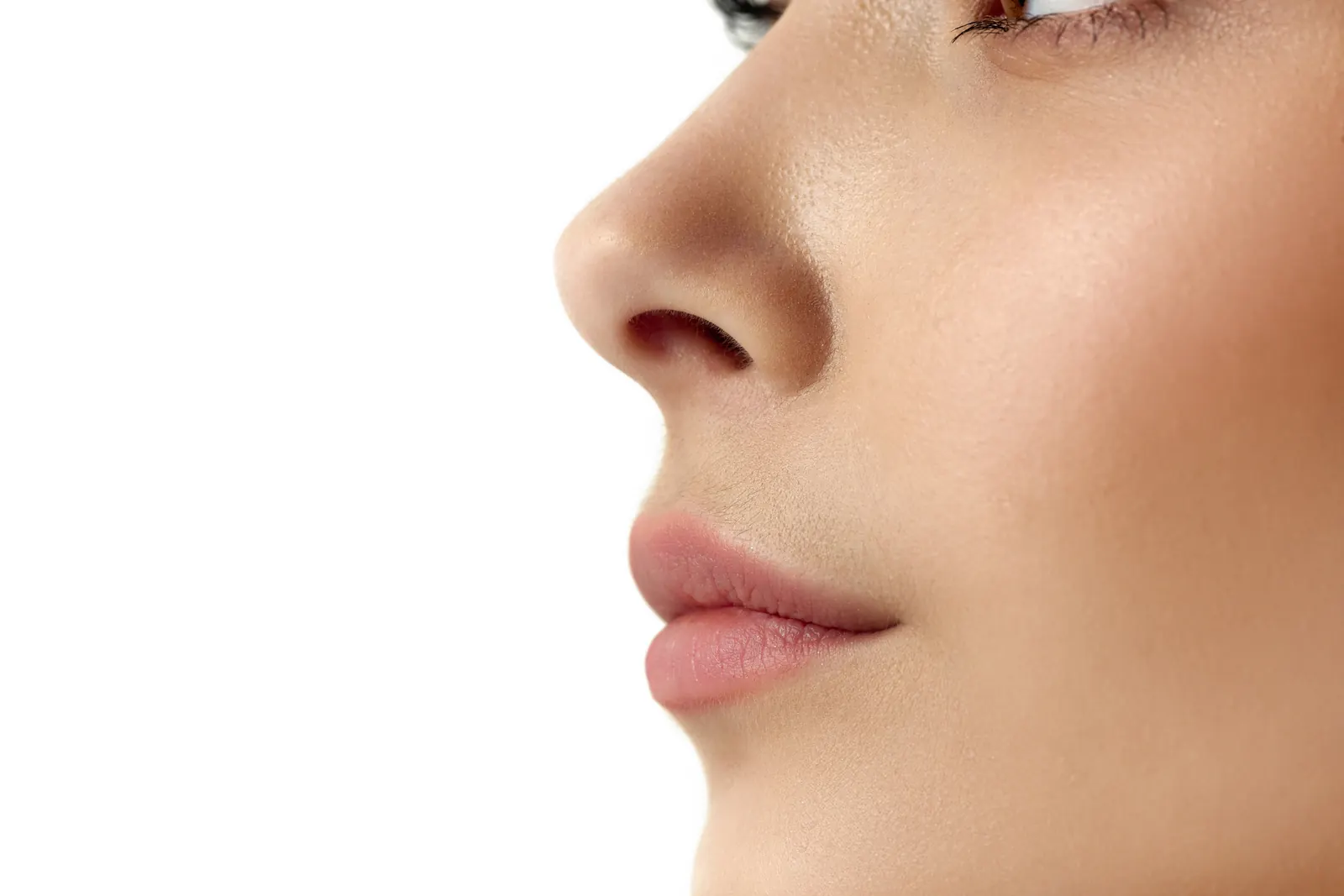
Rhinoplasty is surgery to reshape the nose. The surgeon works on the underlying bone and cartilage to change the appearance of the nose, its function, or both. It is a highly individual operation: the aim is a nose that suits your face rather than a single standardised shape.
People choose it for a range of reasons, commonly to soften a bump on the bridge, refine or reposition the tip, narrow the nostrils, or improve balance and symmetry. Where a deviated septum or other blockage affects breathing, the same operation can also have a functional purpose.
“Rhinoplasty” is really an umbrella term covering several techniques and approaches, described below. Which is used depends on your anatomy, what you want to change, whether breathing is involved, and whether it is a first-time or repeat procedure. Surgeons often combine more than one approach in a single operation.
It is worth being realistic about what surgery can and cannot do. It will not guarantee perfect symmetry, create an identical result to someone else’s nose, or change how you feel about unrelated features. Swelling settles gradually and can take up to a year to fully resolve, particularly at the tip, so the final shape is not immediate.
Types & techniques
The names below describe the main approaches you may come across. They are often combined, and which is appropriate depends on your anatomy and goals, something only a qualified surgeon can advise on.
Septoplasty
Surgery to straighten a deviated septum, the wall of cartilage and bone that divides the nostrils. It is a functional operation aimed at improving breathing rather than changing appearance, and is often carried out alongside cosmetic reshaping.
Open rhinoplasty
The framework of the nose is accessed through a small incision across the columella (the strip of skin between the nostrils) as well as inside the nose. This gives the surgeon a direct view and more control, so it is often chosen for complex or revision cases. It leaves a small external scar that usually fades well.
Closed rhinoplasty
All incisions are made inside the nostrils, so there is no external scar. It suits many first-time cases, though it gives the surgeon a slightly more limited view of the structures than the open approach.
Septorhinoplasty
Combines a septoplasty with cosmetic reshaping in one operation. It addresses both the appearance of the nose and a breathing problem caused by a deviated septum at the same time.
Endoscopic rhinoplasty
Uses a small camera to assist parts of the procedure, most often where the sinuses or deeper internal structures are involved. It is a tool used within an operation rather than a distinct style of nose reshaping.
Preservation rhinoplasty
A group of newer techniques that aim to preserve and reposition the natural structures of the bridge rather than removing and rebuilding them, for example to lower a bump. Supporters suggest it can give a natural result, but it is not suitable for every nose.
Tip rhinoplasty (tip-plasty)
Focuses only on refining the tip of the nose, such as its projection, rotation or definition, without altering the bridge. It is a more limited procedure than a full rhinoplasty and suits people whose concern is confined to the tip.
Revision / secondary rhinoplasty
A further operation to correct or refine the result of previous nose surgery. It is usually more complex than a first-time procedure because of scar tissue and altered anatomy, and it often relies on cartilage grafts to rebuild support.
Ethnic rhinoplasty
Reshaping that works with the features of a person’s ethnic background, respecting individual and family characteristics rather than aiming for one standardised shape. It calls for experience across a wide range of nasal anatomy.
Who might consider it
The points below describe reasons people commonly explore this procedure. They are not eligibility criteria, only a qualified surgeon who has assessed you can advise whether it is appropriate for you.
People who have felt self-conscious about the shape or size of their nose over a sustained period.
People whose nasal shape or a deviated septum affects their breathing.
People seeking to restore shape after an injury.
Whether it is appropriate for you depends on your anatomy, health and expectations, and can only be assessed by a qualified surgeon in person.
What happens during the procedure
1Under general anaesthetic (occasionally local with sedation), the surgeon accesses the underlying framework either through small incisions inside the nostrils (closed) or with a tiny additional incision across the columella (open).
2Bone and cartilage are then reshaped, reduced or, in some cases, augmented with grafts.
3A splint is usually applied to the outside of the nose to support it while it heals.
4Most people go home the same day or after one night.
Recovery, stage by stage
First 24–48 hoursExpect a blocked, congested feeling, mild discomfort and tiredness. Rest with your head elevated.
First weekA splint stays on for roughly a week. Bruising and swelling around the eyes are common and start to fade towards the end of the week.
Weeks 2–4The splint comes off and most visible bruising resolves. The nose will still look swollen, particularly at the tip.
Return to workMany people return to desk-based work after 1–2 weeks, once the splint is off and bruising has faded.
ExerciseLight activity after 2–3 weeks; contact sport and anything risking a knock is usually avoided for 6 weeks or more.
Longer termSubtle swelling settles gradually over 6–12 months, which is when the true final shape emerges.
Risks & considerations
Every procedure carries risks. The general points below are for information only and are not a complete list.
As with any surgery: bleeding, infection, and reaction to anaesthetic.
Persistent swelling, numbness or altered sensation in the nose.
Asymmetry, an unsatisfactory shape, or breathing changes that may require revision surgery.
Visible scarring is uncommon with the closed technique but possible with the open approach.
The risks that apply to you, and how likely they are, can only be assessed in person by a qualified, GMC-registered clinician who has assessed your health and goals. Nothing here is medical advice.
Cost
As a guide, this procedure typically costs in the region of £5,000 to £9,000A functional (breathing) element may be treated differently, ask your surgeon. This is an indicative range to help you plan, not a quote. A surgeon will confirm your own cost only after assessing you.
What the price usually covers
Consultation
Sometimes redeemable against the procedure if you decide to go ahead.
Surgeon’s fee
Reflects the surgeon’s training, experience and time in theatre.
Hospital / theatre
Facility, nursing and any overnight stay.
Anaesthesia
The anaesthetist’s fee, where a general anaesthetic is used.
Aftercare & follow-ups
Dressings, support garments and review appointments, check what is included.
Revision policy
What a further procedure would cost if one were ever needed.
What affects the price
Whether the case is primary (first-time) or a more complex revision.
Open versus closed technique and whether cartilage grafts are needed.
The surgeon’s experience and the hospital or clinic setting.
Whether a functional (breathing) component is involved.
Questions to ask your surgeon
A good consultation is a two-way conversation. Consider taking these questions with you.
Do you perform open or closed rhinoplasty, and which would suit my nose and why?
Can I see examples of your results on noses similar to mine?
How long until I will see the final shape, and how much swelling should I expect?
What is your approach if I am not happy once everything has settled?
How many of these do you carry out each year, and what are your own complication rates?
What result is realistic for me specifically, and what are the limitations?
What are the main risks in my case, and how would any complications be handled?
Facial rejuvenation, Rhinoplasty, Blepharoplasty, Body contouring, Abdominoplasty, Post-weight-loss surgery, Breast reconstruction, Breast aesthetic surgery, Head and neck reconstruction, Lymphoedema supermicrosurgery, Reconstructive microsurgery
Most people report congestion and pressure rather than sharp pain. Any discomfort is usually well controlled with prescribed pain relief in the first few days.
When will I see the final result?
A refined shape is visible within weeks, but subtle swelling, especially at the tip, can take 6–12 months to fully settle.
Will there be a visible scar?
Closed rhinoplasty leaves no external scar. Open rhinoplasty leaves a small scar across the columella that usually fades to become difficult to see.
Can rhinoplasty fix my breathing?
It can be combined with functional surgery, such as correcting a deviated septum, to improve airflow. Discuss any breathing issues at your consultation.
What if I need a revision?
A proportion of rhinoplasties need a minor revision. Ask your surgeon about their revision rate and policy before you commit.
We use cookies to improve your browsing experience
For more information please refer to our Privacy Policy.